
Choosing the wrong grass for your southern lawn is an expensive mistake. The right warm season grass survives summer heat, recovers from drought, and stays thick and green from spring through fall. The wrong one struggles, thins out, and costs you money in repairs.
Warm season grasses grow actively in soil temperatures between 80°F and 95°F. They go dormant in winter and green up again once temperatures rise in spring. The four most common types for southern lawns are Bermudagrass, Zoysiagrass, St. Augustinegrass, and Centipedegrass. Each one has different strengths, weaknesses, and ideal growing conditions.
This guide breaks down all four so you can pick the right one for your yard.
Key Takeaways
- Bermudagrass handles the most traffic — it’s the top choice for high-use lawns and full-sun yards in hot climates.
- Zoysiagrass offers a balance of hardiness and beauty — it tolerates shade, drought, and foot traffic better than most warm season grasses.
- St. Augustinegrass is the best warm season option for shade — it’s the only one that performs well under heavy tree cover.
- Centipedegrass is the lowest-maintenance choice — it grows slowly and needs less fertilizer, mowing, and water than the others.
- Establishment method affects cost and timeline — sod establishes fastest, seed is cheapest (where available), and plugs offer a middle ground.
- Soil temperature drives green-up timing — warm season grasses don’t break dormancy until soil temps hit 65°F consistently.
What Makes a Grass “Warm Season”?
Quick Answer: Warm season grasses grow best when soil temperatures are between 80°F and 95°F. They thrive in the South’s hot summers, go dormant and turn brown in winter, and green up again in spring when soil warms above 65°F.
Warm season grasses use a photosynthesis pathway called C4, which lets them convert sunlight into energy more efficiently in high heat. Cool season grasses use C3, which works better in moderate temperatures. This is why Kentucky Bluegrass struggles in Georgia summers and Bermudagrass struggles in Minnesota winters.
The “warm season zone” covers roughly the southern third of the United States. This includes the Gulf Coast, the Southeast, the Southwest, and the transition zone — a band of states like Tennessee, North Carolina, and Arkansas where both grass types can survive.
What Is the Warm Season Grass Growing Zone?
The warm season belt runs from USDA Hardiness Zones 7 through 10. Within this zone, summers are long and hot, winters are mild, and the frost-free season stretches 200 to 365 days per year. These conditions give warm season grasses enough growing time to establish and maintain dense turf.
In the transition zone, warm season grasses may struggle during colder winters. Zoysiagrass and Bermudagrass have the best cold tolerance among the four and perform better in the upper edges of the warm season belt.
How Do the Four Main Warm Season Grasses Compare?
Quick Answer: Bermudagrass leads for heat tolerance and traffic. Zoysiagrass balances shade, drought, and durability. St. Augustinegrass excels in shade but needs more water. Centipedegrass is the easiest to maintain but least durable. Your best choice depends on sun exposure, foot traffic, and how much maintenance you want.
| Grass Type | Heat Tolerance | Shade Tolerance | Drought Tolerance | Traffic Tolerance | Maintenance Level |
|---|---|---|---|---|---|
| Bermudagrass | Excellent | Poor (needs 6+ hrs sun) | Very Good | Excellent | High |
| Zoysiagrass | Very Good | Good (tolerates 3-4 hrs sun) | Good | Very Good | Medium |
| St. Augustinegrass | Good | Very Good (tolerates 2-3 hrs sun) | Fair | Fair | Medium-High |
| Centipedegrass | Good | Fair (needs 4+ hrs sun) | Fair | Poor | Low |
Is Bermudagrass the Best Choice for Hot, Sunny Southern Lawns?

Quick Answer: Bermudagrass is the best option for full-sun lawns in the deep South that get heavy use. It handles extreme heat, recovers quickly from damage, and stays dense under high foot traffic. It needs at least 6 hours of direct sunlight daily to perform well.
Bermudagrass Growth Habits and Appearance
Bermudagrass spreads aggressively through both above-ground runners (stolons) and below-ground runners (rhizomes). This dual spreading habit is why it recovers so fast from damage and why it can invade flower beds if you don’t manage the edges.
The texture ranges from fine to medium depending on the variety. Common Bermuda has a medium texture. Hybrid varieties like TifTuf, Tifway 419, and Celebration have a finer, denser texture that looks more like a golf course fairway.
What Are Bermudagrass’s Water and Fertilizer Requirements?
Bermudagrass needs about 1 to 1.25 inches of water per week during active growth. It can survive short drought periods by going semi-dormant and recovering when rain returns. For a dense, green lawn, regular irrigation during dry stretches is still necessary.
Fertilizer needs are higher than other warm season grasses. Bermudagrass performs best with 3 to 6 pounds of nitrogen per 1,000 square feet per year. This means more fertilizer applications but also faster growth and a thicker lawn.
| Variety | Texture | Mowing Height | Establishment | Best Use |
|---|---|---|---|---|
| Common Bermuda | Medium | 1–2 inches | Seed or sod | Budget lawns, large areas |
| TifTuf | Fine | 0.5–1.5 inches | Sod or plugs only | Home lawns, drought areas |
| Tifway 419 | Fine | 0.5–1.5 inches | Sod or plugs only | Sports fields, home lawns |
| Celebration | Fine-Medium | 0.75–1.5 inches | Sod only | Home lawns, shade edges |
Where Does Bermudagrass Struggle?
Shade is Bermudagrass’s biggest weakness. Under trees or in areas that receive less than 4 to 6 hours of direct sunlight, Bermudagrass thins out quickly and cannot recover. If your yard has significant shade, a different grass is a better fit.
Bermudagrass also has poor cold tolerance compared to Zoysia. In Zone 7 and parts of Zone 8, harsh winters can kill Bermuda or leave it dormant for 4 to 5 months, which creates a long brown period.
Is Zoysiagrass a Good All-Around Warm Season Grass?
Quick Answer: Zoysiagrass is one of the most versatile warm season grasses. It tolerates moderate shade, handles foot traffic well, and has good drought resistance. It grows slowly, which means less mowing — but also slower recovery from damage and higher upfront establishment costs.
Zoysiagrass Texture, Density, and Appearance
Zoysia forms a dense, carpet-like lawn with a fine to medium texture. The density is one of its biggest advantages. A thick Zoysia lawn naturally crowds out weeds without heavy herbicide use.
It spreads through stolons and rhizomes, similar to Bermuda, but at a much slower rate. Established Zoysia can take 2 to 3 years from plugs or sprigs to fill in completely, which is why many homeowners choose sod for faster results.
How Much Water and Maintenance Does Zoysiagrass Need?
Zoysia needs about 1 inch of water per week during the growing season. Its deep root system helps it survive dry periods better than St. Augustine. During mild drought, it slows growth but rarely goes fully dormant.
Fertilizer requirements are moderate: 2 to 3 pounds of nitrogen per 1,000 square feet per year. Zoysia also produces significant thatch (a layer of dead organic matter) and benefits from dethatching every 2 to 3 years to maintain water and nutrient penetration.
What Zoysia Varieties Work Best for Home Lawns?
Zeon Zoysia is a popular choice for home lawns. It has a fine texture, good shade tolerance, and high density. Meyer Zoysia (also called Z-52) is a coarser, more cold-hardy option well suited to the transition zone. Empire Zoysia is a coarser variety prized for faster establishment and broad adaptability.
Is St. Augustinegrass the Right Choice for Shaded Southern Yards?
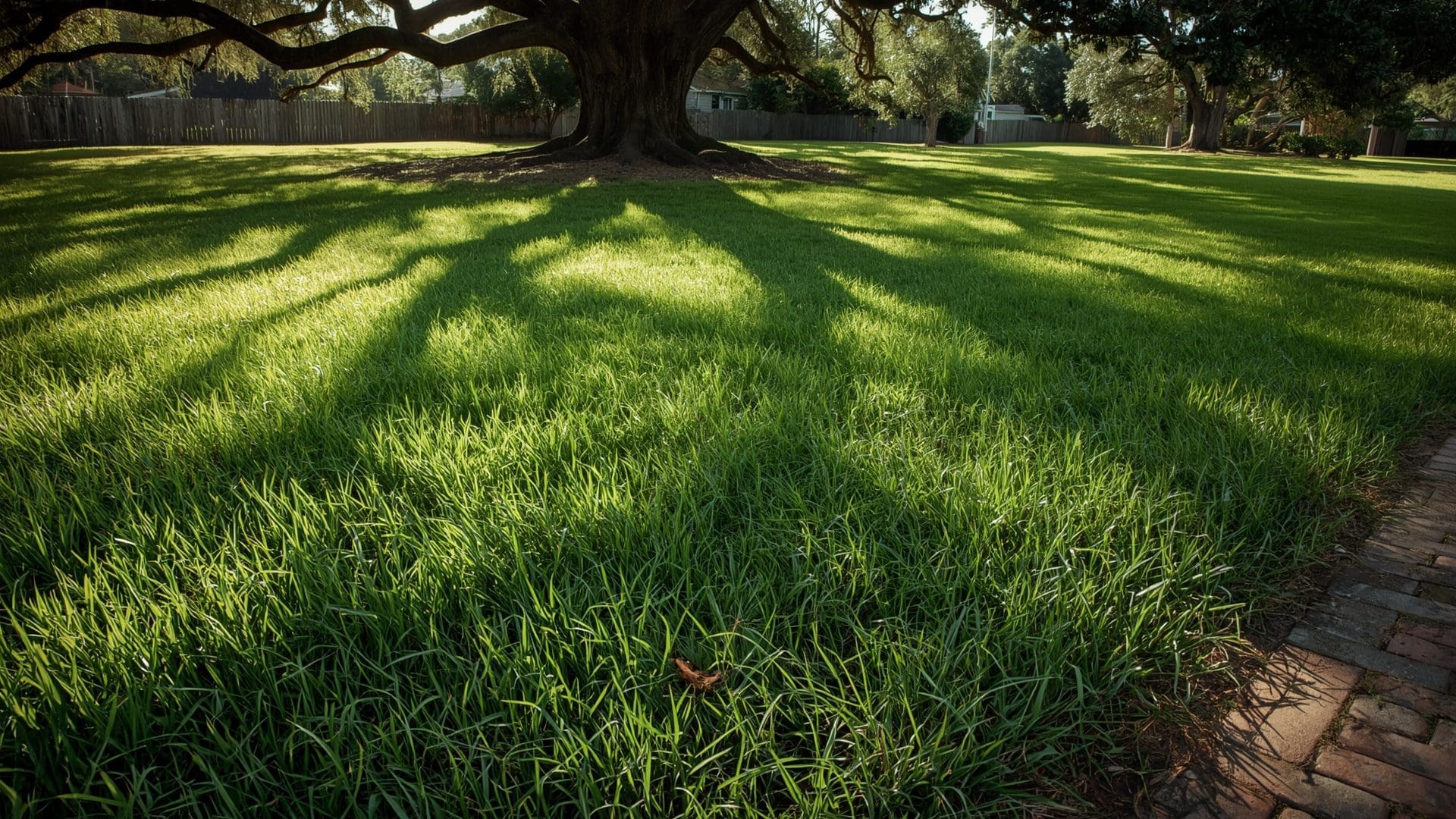
Quick Answer: St. Augustinegrass is the top warm season grass for shaded lawns in the Southeast and Gulf Coast. It stays green under heavy tree cover where other grasses fail. It needs more water and is more sensitive to cold than Bermuda or Zoysia, but no warm season grass beats it in shade.
St. Augustinegrass Appearance and Growth Habit
St. Augustine has the coarsest texture of the four grasses covered here. The blades are wide and flat, giving the lawn a lush, tropical appearance. It spreads only through stolons (above-ground runners), with no rhizomes, which means it recovers more slowly from deep damage.
The lawn establishes quickly from sod or plugs and fills in well during the warm season. It does not produce viable seed, so seed is not available for this grass type.
How Much Water Does St. Augustinegrass Require?
St. Augustinegrass needs 1 to 1.5 inches of water per week and shows drought stress faster than Bermuda or Zoysia. In sandy soils common along the Gulf Coast, watering frequency may need to increase during summer to prevent brown patches.
Signs of drought stress appear as a blue-gray color and folded blades before visible browning. Catching this early and watering immediately can prevent serious damage.
What Pests and Diseases Affect St. Augustinegrass?
St. Augustinegrass is more vulnerable to certain pests than the other three grasses. Chinch bugs are the most damaging pest and are most active in hot, dry conditions. They cause irregular brown patches that spread from sunny areas outward. Sod webworms also feed on St. Augustine and can cause significant damage in late summer.
St. Augustine Decline (SAD), caused by a virus spread by aphids, is a disease that causes yellowing and thinning. Floratam is the most widely planted variety and has some resistance to SAD, though it has lower cold and shade tolerance than other varieties.
| Variety | Shade Tolerance | Cold Tolerance | SAD Resistance | Best Region |
|---|---|---|---|---|
| Floratam | Fair | Fair | Yes | Florida, Gulf Coast |
| Palmetto | Very Good | Good | Partial | Southeast, Transition Zone |
| Seville | Excellent | Fair | Partial | Shaded Florida lawns |
| Raleigh | Good | Very Good | No | Carolinas, upper Southeast |
Is Centipedegrass the Easiest Warm Season Grass to Maintain?
Quick Answer: Centipedegrass is the lowest-maintenance warm season grass available. It grows slowly, needs little fertilizer, and tolerates acidic soils naturally. It’s best for homeowners who want a decent-looking lawn with minimal input — not for high-traffic or heavily shaded areas.
Centipedegrass Growth Habits and Appearance
Centipedegrass has a medium texture and a light green color that distinguishes it from the darker green of Bermuda or Zoysia. It spreads through stolons only, at a slow pace. A new Centipede lawn from seed or plugs can take a full growing season to fill in.
Because it grows slowly, Centipede needs mowing less often than Bermuda. The typical mowing height is 1.5 to 2 inches, and during peak growing season you may only need to mow every 10 to 14 days.
What Are the Fertilizer and Soil Needs of Centipedegrass?
Centipedegrass naturally thrives in acidic soils with a pH of 5.0 to 6.0. It needs very little nitrogen — over-fertilizing Centipede is a common mistake that causes a condition called “Centipede Decline,” where the grass thins, yellows, and struggles to recover.
The recommended nitrogen rate is just 1 to 2 pounds per 1,000 square feet per year. Phosphorus should be applied only when a soil test indicates a deficiency. Centipede is also sensitive to high iron levels in the soil, which can cause yellowing (chlorosis).
Where Does Centipedegrass Perform Poorly?
Centipedegrass is not suited for high-traffic areas. Foot traffic compacts the soil and damages the slow-spreading stolons. Recovery from wear is slow compared to Bermuda or Zoysia.
It also has poor salt tolerance, making it a weak choice for coastal properties exposed to salt spray or irrigation with saline water. And while it tolerates some shade, it performs best with at least 4 to 5 hours of sun per day.
How Do Water Requirements Compare Across All Four Grasses?
Quick Answer: Bermudagrass and Zoysiagrass use the least water per week. St. Augustinegrass needs the most consistent irrigation. Centipedegrass falls in the middle but suffers more from overwatering than the others. Deep, infrequent watering works best for all four types.
| Grass Type | Weekly Water Need | Drought Dormancy | Nitrogen Per Year (lbs/1,000 sq ft) | Ideal Soil pH |
|---|---|---|---|---|
| Bermudagrass | 1–1.25 inches | Yes, recovers well | 3–6 | 6.0–6.5 |
| Zoysiagrass | 1 inch | Yes, recovers moderately | 2–3 | 6.0–6.5 |
| St. Augustinegrass | 1–1.5 inches | Limited tolerance | 2–4 | 6.0–7.0 |
| Centipedegrass | 1–1.25 inches | Limited tolerance | 1–2 | 5.0–6.0 |
Deep, infrequent watering encourages all warm season grasses to develop deeper root systems. Watering to a depth of 4 to 6 inches, then letting the soil dry slightly before watering again, builds drought resistance over time.
What Is the Best Way to Establish Warm Season Grass?

Quick Answer: Sod gives the fastest results in 2 to 4 weeks. Plugs take 3 to 6 months to fill in but cost less. Seed is cheapest where available — only Bermudagrass and Centipedegrass have widely available seed options. Plant in late spring to early summer when soil temperatures exceed 65°F.
Sod Installation for Warm Season Grasses
Sod is available for all four grass types and gives you an established lawn within a few weeks. Lay sod on moist, tilled soil immediately after delivery. Roll it to remove air pockets and water daily for the first two weeks until roots anchor into the soil.
Sod costs range from $0.35 to $0.85 per square foot for the grass itself, plus installation labor if you hire out. A 5,000-square-foot lawn can cost $1,750 to $4,250 in materials alone.
Planting Plugs to Establish Warm Season Grass
Plugs are 2 to 4 inch sections of established grass planted at 6 to 12 inch intervals across bare soil. They work well for Bermuda, Zoysia, and St. Augustine. The spacing affects fill-in time: plugs spaced 6 inches apart fill in two to three times faster than those spaced 12 inches apart.
Water plugs every day for the first two weeks. After they root in, reduce watering frequency to once every 2 to 3 days. Apply a starter fertilizer — one with higher phosphorus content — within the first month to encourage root development.
Seeding Warm Season Grass Lawns
Only Common Bermudagrass and Centipedegrass are reliably available as seed. St. Augustinegrass and hybrid Bermuda varieties (TifTuf, Tifway 419) do not produce viable seed and must be established via sod or plugs.
Broadcast seed when soil temperatures are consistently above 65°F, which typically means late April through June across most of the warm season belt. Keep the seedbed moist until germination is complete — Bermuda germinates in 7 to 14 days, Centipede in 14 to 21 days.
When Should You Plant or Establish Warm Season Grass?
Quick Answer: Plant warm season grass between late April and mid-July in most southern states. This gives the grass a full growing season to establish before the first frost. Avoid planting after August — there’s not enough warm weather left for adequate root development before dormancy.
Soil temperature is more reliable than calendar date for timing. Use a soil thermometer at a 2 to 4 inch depth. Once you see consistent readings above 65°F, conditions are right for planting. Most of the deep South hits this threshold in late March to April.
Avoid planting during drought conditions without an irrigation plan in place. New grass — whether sod, plugs, or seed — cannot survive soil moisture deficits during the establishment phase.
Which Warm Season Grass Is Best for Your Specific Lawn Situation?
Quick Answer: Match the grass to your conditions: Bermuda for full sun and heavy traffic, Zoysia for a versatile all-around lawn, St. Augustine for shaded yards in warm climates, and Centipede for low-maintenance needs in acidic soils with light use. No single grass is best for every situation.
Choosing Based on Sun Exposure
Full sun (6 or more hours): Bermudagrass or Zoysiagrass. Both thrive with maximum sun exposure and produce their thickest, healthiest turf in full light.
Partial shade (3 to 5 hours): Zoysiagrass or St. Augustinegrass. Palmetto and Seville St. Augustine varieties perform especially well in these conditions.
Heavy shade (2 to 3 hours): St. Augustinegrass is your only real option among warm season grasses. Even then, areas with fewer than 2 hours of sun struggle to support any warm season turf.
Choosing Based on Foot Traffic and Use Patterns
High traffic (kids, pets, frequent activity): Bermudagrass is the clear winner. It recovers from damage faster than any other warm season grass and maintains density under constant use.
Moderate traffic: Zoysiagrass handles moderate foot traffic well and holds its structure between recoveries better than St. Augustine or Centipede.
Low traffic (ornamental or lightly used): Centipedegrass is a practical choice. It looks good with minimal maintenance but doesn’t hold up to heavy use.
Choosing Based on Budget and Maintenance Willingness
Lowest cost and maintenance: Centipedegrass seeded or sodded on a basic schedule. The fertilizer and mowing costs are the lowest of any warm season option.
Balanced cost and performance: Common Bermudagrass from seed or Zoysiagrass from plugs. Both offer good results without the premium cost of sod installation for large areas.
Best long-term appearance with lower ongoing maintenance: Zoysiagrass. The higher upfront sod cost is offset by less frequent mowing, lower fertilizer requirements, and better weed resistance over time.
How Do You Keep Warm Season Grass Healthy Through the Seasons?

Quick Answer: Apply fertilizer in late spring after green-up, water deeply and infrequently through summer, and avoid fertilizing after August to prevent cold damage. Dethatch Bermuda and Zoysia every 2 to 3 years. Leave dormant grass alone in winter — do not mow or fertilize until active growth resumes.
Spring Green-Up Care
Wait until your lawn is at least 50% green before applying the first fertilizer of the year. Fertilizing dormant or semi-dormant grass wastes product and can stress the turf. A soil test before the first application tells you exactly what nutrients are needed and prevents over-application.
Scalp mowing — cutting the lawn lower than its normal height — is a useful technique in early spring. Set the mower 0.5 to 1 inch lower than normal for one pass to remove dead top growth and help the sun warm the soil faster. This accelerates green-up for Bermuda and Zoysia especially.
Summer Maintenance Priorities
Mow at the right height consistently. Cutting grass too short (scalping during the growing season) weakens roots and invites weeds and disease. Maintain proper heights: Bermuda at 0.75 to 1.5 inches, Zoysia at 0.5 to 1.5 inches, St. Augustine at 3.5 to 4 inches, and Centipede at 1.5 to 2 inches.
Watch for pest activity in July and August, especially chinch bugs on St. Augustine and armyworms across all four grass types. Catching pest damage early limits the spread significantly.
Fall and Winter Dormancy Preparation
Stop fertilizing 6 to 8 weeks before the average first frost date for your area. Fertilizing late in the season pushes new tender growth that is easily damaged by cold. In Zone 7 and parts of Zone 8, this means stopping fertilizer applications by early September.
Dormant warm season grass is brown but not dead. Avoid heavy foot traffic on dormant Bermuda or Zoysia, as the frozen or brittle grass blades can break and damage the growing points at the base of each plant.
Frequently Asked Questions About Warm Season Grass Types
Can you mix different warm season grasses in the same lawn?
Mixing warm season grasses generally leads to a patchy, uneven appearance. Each type has different textures, colors, and growth rates. Bermudagrass will aggressively spread into Centipede or St. Augustine areas over time. For a clean, uniform lawn, choose one grass type and maintain it consistently.
Do warm season grasses need to be overseeded in fall?
Warm season grasses themselves don’t need overseeding. However, some homeowners overseed with annual ryegrass in fall to maintain green color through the winter dormancy period. This adds visual appeal but requires a transition period in spring as the ryegrass dies out and the warm season turf takes back over.
How long does it take for warm season grass sod to root?
Most warm season sod varieties root within 10 to 21 days under normal conditions. You can test rooting by gently tugging a corner of the sod — if it resists pulling up, roots have started anchoring. Full deep rooting takes 4 to 8 weeks, after which the lawn can handle normal foot traffic and mowing.
What causes warm season grass to turn yellow in summer?
Summer yellowing usually signals an iron deficiency, nitrogen deficiency, overwatering, or pest damage. Centipedegrass is especially prone to yellowing from over-fertilizing or high soil pH. A soil test identifies the exact cause. Iron sulfate or chelated iron products correct iron deficiency quickly without the risk of pushing excessive growth.
Is Zoysiagrass or Bermudagrass better for the transition zone?
Zoysiagrass typically performs better in the transition zone because of its stronger cold tolerance. Meyer Zoysia survives temperatures as low as 0°F in some cases. Bermudagrass can die back in the upper transition zone during harsh winters, requiring reseeding or resodding in spring. Zoysia holds its root system more reliably through cold snaps.
Can warm season grass grow in containers or raised beds?
Warm season grasses are not suited for containers or raised beds. They need large expanses of soil for their stolon and rhizome root systems to spread properly. In restricted root environments, they thin out quickly, dry out faster, and lack the growth space needed to stay healthy. They’re ground-cover plants designed for open soil.
